Friday, October 27, 2006

As violence grows, oil-rich Kirkuk could hold key to Iraq's future

Tribal chiefs call for return of Saddam while Kurds eye a new federal state
Michael Howard in KirkukFriday October 27, 2006


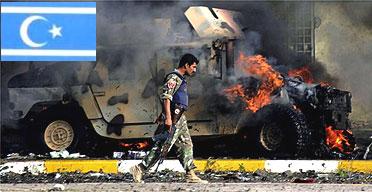
An Iraqi police commando walks by a burning humvee at the site of a suicide car bombing in the northern Iraqi oil hub of Kirkuk. Photograph: Marwan Ibrahim/AFP/Getty images
The tribal chiefs, in traditional robes and chequered headdresses, emerged from the dust stirred up by their convoy of pick-up trucks and walked towards the big white tent, gesturing welcomes to each other as they sat.
Accompanied by about 500 clansmen and a gaggle of local journalists, the 35 Sunni sheikhs - from Mosul, Tikrit, Samarra and Hawija - converged last week on Hindiya, on the scrappy western edges of Kirkuk, to swear their undying opposition to "conspiracies" to partition Iraq and to pledge allegiance to their president, Saddam Hussein.
Under banners exalting the man now standing trial in Baghdad for war crimes and genocide, the gathering heard speeches from prominent northern Iraqi sheikhs, Sunni Arab politicians and self-declared leaders of the Ba'ath party calling for the former dictator's release.>>>>>>

Tuesday, October 24, 2006

Conference; Kerkuk and reflections on the Turkmen situation and Iraq

Mondiaal centrum / Stichting Tanis
Lange Herenvest 122 2011 BX Haarlem Netherlands
www.tanis-turkmen.nl
Subject: Conference about the referendum in the city Kerkuk / Iraq
Date : 05-11-2006
Address : De Balie Kleine-Gartmanplantsoen 10 1017 RR Amsterdam


After the 2003 war brought an end to the despotic Ba’ath regime, the Turkmen as an indigenous people expected to see democracy, fairness, an end to discrimination, the right to self-determination and an end to violence. Unfortunately, the opposite has occurred regarding the human rights situation in Iraq, in particular concerning the Iraqi Turkmen.
The ocean of oil beneath its surface could be used to drive the economy of an independent Kurdish State, the ultimate goal for many Kurds. The Kurds hope to make the city of Kerkuk and its vast oil reserves part of an autonomous region whereas the Turkmen, Chaldo Assyrians and Arabs are fiercely opposing the inclusion of Kerkuk in an autonomous region. A Kurdish control over Kerkuk could fuel Kurdish nationalism in the region and undermine the rights of Turkmen, Arab and Chaldo Assyrian residents in Kerkuk and the city of Kerkuk itself has become almost synonymous with the abusive Kurdization campaign, which illustrates the persistency of the designs that the Kurds have on Kerkuk. This could lead to instability in the region and, possibly, civil war.
The Turkmen, as staunch believers in firm national principles, strongly reject article 58 and its clauses in the Iraqi constitution that are of great prejudice against the Turkmen and their national identity. The Turkmen, Arabs and Chaldo Assyrians are extremely worried over efforts aiming to make Kurds a majority in the northern Iraqi town of Kerkuk.
Due to the planned referendum to be held in Kerkuk late 2007, the issue of Kerkuk's status became potentially explosive for Iraq, and ethnic conflict over the city could spark violent clashes and even a civil war across Iraq, that could eventually lead to disintegration of the country.
Unless the international community acts soon to resolve mounting tensions in Kerkuk, the result could well be another violent communal conflict in Iraq, risking full-scale civil war and possibly outside military intervention. Thus a conference has been called by Iraqi Turkmen association “ Tanis” in Holland which would be held on the 5/11/2006 on the above subject.
Page 1
TIMETABLE OF THE DAY EVENTS ON THE 5/11/2006
14.00PM: INTRODUCTION SPEECH BY THE PRESIDENT OF THE IRAQI TURKMEN ASSOCIATION (TANIS), MR. YALCHIN MUTAPCHI (10 MINUTES).
14.10PM: DISCUSSION ON THE HISTORY OF IRAQI TURKMEN BY DR. MOHAMMED SAAID AL-TURAYHI ISLAMIC UNIVERSITY ROTTERDAM (20 MINUTES).
14.30PM: A STUDY FOR THE POLITICAL SITUATION FOR THE IRAQI TURKMEN IN THE PAST AND PRESENT BY PROFESSOR DOCTOR SUPHI SAATCHI MIMAR SINAN UNIVERSITY ISTANBUL (30 MINUTES).
15.00PM: RREADING ABOUT A REFERENDUM IN KERKUK YEAR 2007 BY ASIF ISMAIL REP. OF IRAQI TURKMEN FRONT IN ENGLAND (20 MINUTES).
15.20PM: COFFEE BREAK (30MINUTES)
15.50PM: WITH THE QUESTIONS AND THE ANSWERS OPENED THE
DISCUSSIONS DOOR (45 MINUTES).
16.35PM: SUMMING UP
Gastes: Mr. Bertus Hendriks, World broadcasting in Amsterdam.
Prof. A. Bayat, chairman of Islamic university The Modern World (ISIM) in Leiden.
END THE SESSION
For further information on the above conference please contact us on the following email info@tanis-turkmen.nl
Mobl: 0640318673

Thursday, October 12, 2006

Taliban Of Afghanistan And Talabani Of Iraq-Kurdistan: The Stan Of American Quandary

By Ali Al-Hail
Al-Jazeerah, October 11, 2006
Recent frantic shift by the neocons in the US to negotiate with Taliban of Afghanistan, and to support demands from the Kurds led by Talabani, and Barzani of Iraq-Kurdistan conceivably, reflects the dilemmas they are facing in Afghanistan, and Iraq. Taliban forces in Afghanistan, after 5 years since the neocons’ war are stronger now than they have ever been, and in full intact. More significantly, inflicting high toll on the US-led NATO (IESAF) forces.
All the neocons’ reporting of quantifying killing of Taliban’s troops daily, has proved to be false, and is information withheld. Bombing Afghani civilians in thousands, including children, and women over the past half a decade has, for media consumption been perceivably, fabricated for killing Taliban fighters.
Strangely, enough in the last three months, American, British, Canadian, and now Nato sources have been alleging killing hundreds of Taliban fighters. Whilst field reports from Afghanistan show on daily basis Taliban frequent, and consistent attacks on Nato, American, British, and Canadian paratroops at the heart of Kabul, which is absolutely, incompatible with the Nato’s statistics. This situation has apparently, forced the neocons in the US to handle Taliban’s predicament to first the British, and Canadians, and lately, to the NATO.
As NATO forces have been facing fierce resistance from Taliban fighters, a good number of NATO countries were skeptical about sending troops to Afghanistan. Now there are confirmed reports by the NATO in fields that, three quarter of Afghanis are reported to have turned to Taliban, as their lives have drastically, been worsened, and not improved according to what they were promised 5 years ago.
The neocons have apparently, came to terms with the reality that, Taliban, like HizbullaH, the resistance in Iraq, the resistance in Palestine cannot be defeated, and the remaining way to deal with Taliban, is to negotiate with them.
As for Iraq, the neocons had it with their ‘opportunistic’ allies, the Shi’is, since they had completely, failed, among other issues to stop the resistance against the neocons-led coalition occupation. As a matter of fact, both the occupiers, and the puppet government headed by Nouri Al-Malki share this perceived failure. This harsh veracity has reportedly, pushed the neocons to direct the winds to the Kuds, further up in the North, accumulated by a visit recently, by Dr. Rice, the neocons’ secretary of state. A number of visits made by Talibani, and Barazani to the US has also, served this trend. Assuredly, is another quandary facing the neocons, and this time with Turkey.
The Iraqi- Kurd President, Talabani, and Barzani, the President of Iraq-Kurdistan eagerness for more autonomy, and for controlling the oil of Kirkuk, has allegedly, fallen upon listening ears of the neocons in the US.
Turkey does naturally, not seem to be pleased with the neocons’ closeness to the Kurds, who are edging their borders from the South. They already have a huge headache with the PKK inside their Southern-Eastern part of their country.
Since Turkey is a Nato member, and has always, been obedient to the neocons, since the first American Gulf war on Iraq in 1991, after the Iraqi invasion of Kuwait, Turkish government monitors this new development with extreme vigilance. If a full independent, sovereign Kurdish state has to be founded at Northern Iraq, as indications point at this way Turkey will certainly, have its panics, and legitimate fears.
As the Kurds of Turkey, who have for centuries been demanding a Kurdish state at Southern-Eastern Turkey without a potential prospect, would take up the opportunity, and would join the seemingly, Kurdish promised state. Since the Kurds have never hidden their bitter feelings about the Turks, and vice versa the new state could become a source of serious threat to Turkey. Especially, if Kurkuk will be given away to them, as part of their state, which would make the Kurds rich and upper handed only, a few miles from the borders with Turkey.
A question arises here, will the Arab World accept another Foreign state (Israel is the first to be imposed on the Arab World)?, or else the neocons will be able to make them approve of it, as they have approved of Israel. Is the new US-led 8-Arab-state-Axis, amongst its agenda, is to do this?
Though, there is no ‘official’ contact between Taliban of Afghanistan, and Talabani, and his Kurds, both are predominantly, Muslim-Sunni. As such, Muslim movements in Iraq-Kurdistan, as well as ordinary Kurds, do have sympathy with Taliban, and Al-Qaeda.
Moreover, amongst Kurds supporting both Talibani, and Barazani, the two main influential secular leaders in Iraq-Kurdistan also, have a degree of sympathy with Taliban, and Al-Qaeda. They however, by backing their secular leaders, look forward to having a state which enjoy the neocons’ support, as they are now in Iraq, are the main influence upon the puppet government of Al-Maliki. Thus, it’s a business bargain, and opportunistic relations between the Kurds, and the neocons in the US, albeit, the Kurds’ radical stand historically, against the West.
Despite the fact that, Salahuddin, the Muslim-Kurd leader liberated Jerusalem during the Crusade Wars in the 11th century, secular Kurds led by Talabani, and his ally, Barzani at present are loyal to the US, and Israel. Israel, and the West generally, however, wouldn’t forgive the Kurd nation, for Salahuddin, whose name, and deeds stand as a role model for Arabs, and Muslims.
Wednesday, September 27, 2006

Part of Iraq Intelligence Report Is Released

Part of Iraq Intelligence Report Is Released
'Political' Leaks of Paper Led to Decision, Bush Says

'Political' Leaks of Paper Led to Decision, Bush Says

By Michael A. Fletcher
Washington Post Staff Writer
Wednesday, September 27, 2006; Page A01

The Bush administration yesterday released portions of a classified intelligence estimate that says the global jihadist movement is growing and being fueled by the war in Iraq even as it becomes more decentralized, making it harder to identify potential terrorists and prevent attacks.

The war in Iraq has become a "cause celebre" for jihadists, breeding resentment of U.S. involvement in the Muslim world and drawing new adherents to the movement, the assessment says. The growth in the number of potential terrorists is also being fed by corruption, slow-moving political reform in many Muslim countries and "pervasive" anti-American sentiment, according to the report.

Tuesday, August 29, 2006

Results Notification of Consultation Meeting

ITF Press
28.08.2006
The Results of the 2nd Consultation Meeting which was organized by the Iraqi Turkmen Front and the participation of Turkmen organizations outside Iraq was held in Ankara on the 22-23rd of August 2006 have been undersigned and a decision was taken to release them to the public: "The ITF, which was born from the bosom of Turkmeneli with the intent of uniting the Turkmen under one roof, has entered the politization process in its 11th year and starting from 2005. ......>

Saturday, August 26, 2006

'Iraq Undergoing a Critical Period', Says Turkish Iraqi Leader


Speaking at a meeting held on Tuesday in the Turkish capital Ankara, Iraqi Turkmen Front (ITC) chairman Sadettin Ergec has said that Turkomans were moving through a critical period.
Today's meeting which brought together representatives of Turkomans living outside Iraq took place at the Ankara Turkmeneli Culture Center. The ITC Chairman stated in his speech that the Iraqi Turkomans were struggling for their existence in the country.....>

Oil-rich Kirkuk must remain Iraqi city

ANKARA - Turkish Daily News
Turkmen groups have said the inclusion of the disputed northern Iraqi city of Kirkuk within the local Kurdish government in the north of Iraq cannot be accepted. “Under the current circumstances, a referendum slated for late 2007 will not solve the problem. In fact, decisions made on Kirkuk are contradictory and lack a legal basis,” said a draft summary issued yesterday after a two-day meeting of Turkmen groups in Ankara. .....>

ITC: Annexation of Kirkuk unacceptable

Friday , 25 August 2006
The Iraqi Turkmen Front (ITC) yesterday expressed its opposition to the oil-rich city of Kirkuk coming under the Iraqi Kurdistan regional government and called for a special status for the city.
The ITC and around 60 political groups and organizations from the Turkmen diaspora issued a final declaration yesterday following a two-day meeting in Ankara.
Underlining that the Kirkuk issue is the main priority of Iraqi Turkmens, the ITC expressed its support for Kirkuk being given a special status like Baghdad and not being controlled by any regional administration. It also warned that Turkmens will continue their struggle against injustices against Turkmens using all democratic means.

Iraq: Kirkuk Must Remain An Iraqi City

August 25, 2006 16 40 GMT
The oil-rich northern Iraqi city of Kirkuk must not come under the control of the regional government of Kurdistan, Turkomen groups said in a statement Aug. 25. The Turkomen added that if Kirkuk does not remain under Iraqi control, they will use every means within their rights to end injustices taking place in Turkomen-populated areas.

Three Turkmen shot dead in Kirkuk after Turkmen-Kurd fighting in nearbytown

Sat Aug 23, 6:20 PM ET
KIRKUK, Iraq (AFP) - Three Turkmen were shot dead by police in Iraq
(news - web sites)'s northern oil-rich city of Kirkuk, Kirkuk GovernorAbdul Rahman Mustafa said. The deaths came a day after fighting between Turkmen and Kurds in nearbyTuz Khurmatu left eight dead on both sides, while two more Turkmen werekilled by US soldiers as the US-led coalition faced the spectre ofgrowing ethnic fighting. The three Turkmen were gunned down after they opened fire on a policebuilding during a demonstration, Mustafa said. "Elements seeking to destabilize Kirkuk ... exploited the peacefuldemonstration and opened fire on the police building without anyjustification, prompting the police to return fire," Mustafa told AFP. "This led to the killing of three of the demonstrators," he said. Three policemen, including an officer, were also wounded. Irsan Kirkuly, a Turkmen member of the city's local council, earliertold AFP that three Turkmen were arrested during the protest. Three cars, including a police vehicle, were destroyed. Colonel Bill Mayville, commander of US-led coalition forces in Kirkuk,met with representatives of all communities in the multi-ethnic city --which is home to Kurds, Arabs, Turkmen and Assyrian Christians -- in aneffort to restore calm. "The situation is now secure in the town," Mustafa said, after mostresidents had rushed to their homes and shop-owners shut their stores. Demonstrators included residents of Tuz Khurmatu, where fighting betweenKurds and Turkmen on Friday left eight dead on both sides and anothertwo Turkmen were killed by US soldiers. According to Kahya Galib, a member of the Iraqi Turkmen Front, thefighting in Tuz Khurmatu, 60 kilometers (40 miles) south of Kirkuk,broke out after unidentified elements fired a rocket-propelled grenadeat a Shiite religious site revered by Shiite Turkmen residents. A town official told AFP that eight people, five Turkmen and threeKurds, were killed in the clashes, which he blamed on elements of thetoppled Baath Party of ousted Iraqi president Saddam Hussein (news - websites). Ten Turkmen and three Kurds were injured, said Tuz Khurmatu's Kurdishmayor Mohammad Rashid Mohammad. US soldiers also killed two Turkmen during a demonstration in TuzKhurmatu Friday, a US military spokesman said. Friday's fighting broke out amid deep tensions in the town between itsKurdish majority and Arab and Turkmen minorities. Tuz Khurmatu was sealed off by US troops Saturday, said an AFP reporteron the site. Lieutenant Colonel Bill MacDonald said 4th Infantry Division soldiersentered the town in response to reports of "Iraqi-on-Iraqi violence"erupting during what he thought was a Turkmen demonstration. Upon entering the town, a US military patrol was fired on by a group offour Turkmen, MacDonald said. The soldiers responded and "killed two of them and slightly wounded twoothers," he added. "Local leaders were able to calm down the situation and disperse thecrowd. An investigation is ongoing." Captain George Swenson, who heads coalition forces in Tuz Khurmatu, toldAFP that the town was "stable but still on knife" Saturday. Tensions have risen in Tuz Khurmatu as the Kurds have demanded that thetown be transferred to the Kurdish-majority governorate of Kirkuk fromthe Arab-majority province of Salahuddin, in which it currently lies. A Turkmen representative in the Kurdish city of Arbil, Jawdat al-Najar,said the clashes in Tuz Khurmatu were provoked by "those who don't wantstability in Iraq." Najar, who is president of the Turkmen cultural association, called onTurkmen and Kurds to avoid any further confrontation and find a peacefulsettlement. About 200 Kurds protested outside the Kirkuk government building lastSunday demanding that they be incorporated within the province. Arab police officers complained last week at a checkpoint outside thetown that Kurds were dominating life in Tuz Khurmatu, grabbing all keygovernment positions and businesses since Saddam's fall in April.

Friday, August 18, 2006

Maliki on United Iraq

"It's significant to note that the one thing he [Mr. Maliki] said was that Arabs, Kurds, Christians, Sunni, Shia, and Turkmen should be united with each other to form a country united to defeat terrorism." .......>

Call for release of newspaper editor kidnapped in Baghdad

Iraq 18.08.2006
Reporters Without Borders voiced concern today about the fate of journalist Seif Abd al-Jabbar al-Tamimi, who was kidnapped on 15 August in the Al Adil district of Baghdad. His abductors have not yet made any demands and it has yet to be clearly established whether his kidnapping is linked to his work as editor of Al-Akha, a newspaper that supports a party that defends Iraq’s Turkmen minority.
“We call for the immediate release of Tamimi and all the other journalists and media assistants held in Iraq,” Reporters Without Borders said. The organisation is still hoping for the release of three others who have been kidnapped.
Iraqi journalist Reem Zeid and her colleague Marwan Khazaal of Sumariya TV have been hostages for more than six months. They were kidnapped by four gunmen on 1 February as they left a news conference at the headquarters of the Iraqi Islamic Party in the west Baghdad district of Yarmouk. Sumariya TV is still without any word of their fate.
Salah Jali al-Gharrawi, an accountant working for the French news agency Agence France-Presse (AFP) in Baghdad, was kidnapped on 4 April by gunmen in two vehicles with tinted windows and no licence plates. More than four months later, AFP is not aware of any claim of responsibility and still does not know who his abductors are.
A total of 49 journalists and media assistants have been kidnapped in Iraq since the start of the war in March 2003. Instead of being afforded a degree of security by the fact that they work for the media, journalists have been singled out as targets.

Tuesday, August 15, 2006

The Turkmen of Iraq: Underestimated, Marginalized and exposed to assimilation Terminology

The Turkmen of Iraq: Underestimated, Marginalized and exposed to assimilation Terminology
2005-06-08
Report of the SOITM on Turkmen of Iraq before the 11th session of Working Group on Minorities – United Nations - Geneva
WORKING GROUP ON MINORITIES11th session(30 May to 3 June 2005, Geneva, Switzerland)
The Turkmen of Iraq: Underestimated, Marginalized and exposed to assimilation Terminology
The term Turkmen, which first appeared in the 9th century, is used to describe the people of Turkmenistan and all the Turkic people in the west and southern west countries of the Caspian Sea: Turkey, Azerbaijan Republic, Azerbaijan of Iran, Arabic countries (Iraq, Syria and others) and the Balkan countries.
HistoryTurkic people were already in Iraq under the Sasanians.2 In the early Islamic era, the Turks arrival in Iraq started with the settlement of about 4000 Bukharan Turks under the Umayyad governor of Basra Ubeydullah Ibn Ziyad in 673 – 674.3 For most of the time when the Abbasids ruled from Baghdad (744 - 1258) the Turkish soldiers were figureheads of the army under Turkish commanders.4 In the Samanid (819 - 999) army the Turkish militia was an important element. In the Buyid (932-1062) army, the Turkmen element was the main military force.5 With the Seljuks the Turkmen became the real sovereigns in Iraq. The Turkmen, who were the second largest nationality in Iraq under the Buyids, had further increased in number during the Seljuk period.6 During the Atabeg era, a large gathering of Turkmen took place in Iraq.7 Other waves of Turkmen entered Iraq in the winter of 1231, when the Mongols defeated the Khawarazm Shah Jalal al-Din, they spread in al-Jazeerah cities: Sinjar, Khabur and Harran. The arrival of the Turkmen in Iraq reached its climax under the Mongols. Turkmen continued to arrive in Iraq at the time of the Qara Qoyunlu, the Aq Qoyunlu and the Ottomans. While the Shabaks (Qizilbash or Alawi) were the Turkmen soldiers of Shah Ismail who came to Iraq under the Safawis.
DemographyThe Turkmen of Iraq live mainly in a region, which stretches from Talafar in the Northwest to Badra and al-Aziziyya in the al-Kut province in mid eastern Iraq. They are found in the following provinces: Kerkuk,9 Mosul, Erbil, Salah al-Din, Diyala, Kut and Baghdad. The largest Turkmen population concentration is found in the city of Kerkuk whose linguistics, cultural and ethnic identity is distinctly colored by their presence.10Tavuk, Taza Khurmatu sub-districts and tens of villages in the Kerkuk province are Turkmen. The number of Turkmen in Erbil city is estimated to be no less than 250.000. Altun Kopri which was detached from Kerkuk in 1976 and annexed to Erbil is a large Turkmen sub-district. The Turkmen of Mosul are living in the large Talafar district (Population is 227,000), sub-districts of Iyadhiyya (11.000) plus 10 villages and Muhallabiyya (8.500) plus 7 villages, the large villages of Qara Qoyunlu (11.000), Rashidiyya (25.000), Shirikhan, Sallamiyya and in the Sinjar (about 20.000) city. There are a large number of Turkmen in Mosul city (about 30.000), the city’s largest area ‘Prophet Jonah’ is a Turkmen neighborhood. Heavily inhabited Turkmen Bayat and Duz Khurmatu districts were annexed to Salah al-Din Province in 1976. Bestamli, Amirli and Sulayman Pak are from the large sub-districts of the latter province. The biggest and heavily Kurdified and Arabified Turkmen cities are found in Diyala province: Kifri District, which was detached from Kerkuk province in 1976, Kara Tepe, Kizil Rabat, Shahraban, Mandali and Khanakin.11,12,13 The Turkmen speakers still constitute a considerable part of the population of Badra in al-Kut province. Those who forgot their mother language are still proud of their Turkmen origin as in al-Aziziyya. According to the Turkmen writers the Turkmen of Baghdad are estimated to be 50,000 families or 300.000 people.
Population sizeThe Turkmen of Iraq are considered the third largest ethnic group in Iraq. Due to the undemocratic environment, their number has always been underestimated. It was fixed at 2% of the total Iraqi population during the negotiations of the Mosul issue in the establishment of the Iraqi State after the World War I.According to McDowell14 the Turkmen outnumbered other nationalities in Kerkuk province as a whole in the 1950s. The population of Kerkuk province was 388,939 of 6.250.000 of the total Iraqi population. The population of Arabs and Christians did not exceed 20-30 thousand in Kerkuk province.15 There should have been at least 180,000 Turkmen in Kerkuk province alone making up 2.9% of the total Iraqi population, not taking into account other Turkmen living in Erbil, Mosul, Diyala etc.Despite missing Turkmen voters in Mosul (not less than half million Turkmen population), Diyala and Baghdad the number of the Turkmen in the present Iraqi National Council is 15, this makes 5.5% of the total.
Political Situation (Tragedy)Since the establishment of the Iraqi State in 1921, the Turkmen are living between the other ethnic groups who had developed high nationalist feelings. The Arabs possessed the power of governing and the Kurds received helps and supports (financial, moral and even weapons) from the international community, while the Turkmen remained helpless. Their Human rights were violated by successive Iraqi governments. Turkmen officials were reduced in the government offices. Study in Turkmen language was terminated in 1932.16. They were exposed to displacement and deportation, deprived from cultural rights, not permitted to register themselves as Turkmen in censuses and they were enforced to change their nationality. Meanwhile the neighboring countries and the international community were and are still unaware of/or indifferent to their lot.17 Unfortunately the Turkmen tragedy, continued after the occupation of Iraq in 2003. Most probably because of the non-cooperative Turkish policy toward the occupation of Iraq, the occupation policy aims to marginalize the Turkmen of Iraq as it happened when the Governing Council and the Temporary Government were constituted. The heavily populated Turkmen district of Talafar has been neglected for about a century: the majority of houses are still built of adobes, the schools and roads have not been renovated for several decades, it has repeatedly been deprived of electricity or water for several months. They had to use the unhealthy water of the small river for washing and drinking. At present piped water from the municipality is provided for only a few hours a week to the houses.Despite extremely sporadic attacks or insult were directed toward the occupying power in the district of Talafar, sub-district Iyadhiyya and recently the large village Rashidiyya are heavily and repeatedly exposed to the attacks of the American tanks and helicopters and of the National Guards, which are constituted mainly of Kurdish Pashmargas.
Distortion of the Demography of the Turkmen regionsArabification. The Arabification policies of Kerkuk City began as early as in the 1930s, when the cabinet of Yasin Al-Hashimi made 2 racist decisions: Termination of study in Turkmen language in 193216 and the huge al-Hawije project to cultivate the vast plain at the west of Kerkuk City to settle the Arab tribes of Al-Ubeyd and Al-Jubur. With the establishment of the Republic, appointment of Turkmen dropped off and the Turkmen were discharged from the important positions in the governmental offices. In the dictatorial Ba’ath period, the assimilation and forced deportation of Turkmen from Kerkuk City started. The Turkmen were not allowed to buy immovable proprieties. After 1970s, Arabs have enjoyed special incentives and rights, which encouraged thousands of families to obey the order of the Ba’ath Party and settle in the historically Turkmen area Kerkuk. In the 1970s, the names of tens of villages and districts in Kerkuk province were officially given Arabic names. Large numbers of Turkmen families were given deportation notification from Kerkuk at the end of November 1993.18 Kurdification. Erbil city was almost completely Turkmen at the turn of the 19th century.12 It is mainly Kurdified and now made the Capital of so-called Kurdistan. The main Turkmen city Kerkuk, which was almost completely populated by Turkmen, was exposed to the Kurdish emigration in the 1930s and 1940s.19, 20 While the reason of Kurdification was economical and social at the beginning, with the set up of Kurdish uprising in the beginning of 1960, it took the form of political trend. McDowall describes the Kurdish policy toward Kerkuk city as follows:“For both Arabs and Kurds the value of Kerkuk city had been greatly enhanced by the nationalization of the oil industry. At the beginning of 1974 oil revenue was expected to be ten times higher than in 1972. A huge resource was now at stake. Kerkuk accounted for 70 per cent of the state’s total oil output and Mulla Mustafa felt bound to claim both the town itself and a proportion of its oil revenue”21The most acute and heavy Kurdish movement into Kerkuk city started with the support of American authorities after the occupation of Iraq. Over a period of a few months about 200.000 Kurds entered Kerkuk. Today, the estimated number of the Kurds, which entered Kerkuk city after the fall of the previous regime is 350,000.22 Thousands of the governmental buildings, were occupied by the Kurdish families and Kurdish Pashmargas. Several Shanty houses, which include hundreds of houses, started to be built around the city.23
Manipulation in the recent general electionIt can be concluded that the manual manipulations are among the largest drawbacks of the preceding Iraqi election, see the reports of the Iraqi Turkmen organizations reference.241. According to UNICEF and the US Department of state the population of Iraq was 25.175.000 in 2003 and 24.011.416 in 2002, consecutively. The Population annual growth rate was 2.82%. Then the Population number at the end of 2004 should be 25.884.935 and 25.375.302. According to UNICEF the percentage of Iraqis above 18 years of age is 52.2%. The total number of voters at the end of 2004 should be 13.511.936 and 13.245.908, consecutively. The voters outside Iraq were 283.460. While the number which the Independent Iraqi Election Commission determined is 14.596.551. The surplus or not present vote number is 0.75 – 1 million.25,26 To whom were these votes counted?.The leading feelings or ideologies of the Iraqi people today are ethnical and religious. From whom the Prime Minister Allawi got 11.689.943.2. Duhok as almost purely Kurdish is one of the smallest provinces of Iraq. The population number of this province is 472.238. The number of voters is 378.990. This makes 80.3% of the population above 18. The percentage of turnout in Duhok was 92%, which is also impossible because there are hundreds of villages between the mountains. In this province the Kurdish alliance won 95%. This reminds that Saddam also won 97%!3. According to the census 1987 the population number in the three Kurdish provinces of Duhok, Sulaymaniyya and Erbil was 1.977.982. The Population annual growth rate from 1990 to 2003 was 2.9%.23 Then the population number in these three provinces should be 3.215.760 and the voters should be 1.678.626. The Kurdish regional government showed the number of voters to be about 2.030.411.4. The real total number of Iraqi voters is accounted as 13.511.936. The real total number of Kurdish voters is 2,243,268. The percentage of the Kurdish voters is 16.6%. According to the most reliable references the Kurdish percentage in Iraq is around 17%. This means that ALMOST ALL the Iraqi Kurds ALL OVER THE WORLD have cast their votes!5. Estimated number of Turkmen in Mosul is not less than 500.000. There cities were mentioned above. For all these Turkmen regions, for which should be instituted more than 30 boxes, there opened only 4 boxes in Talafar. To hamper the election processes, The American forces and the national guards started to bomb the citadel neighborhood of the city at the early morning. Showing the unsafe situation two of the four-election center was closed after a few hours. Despite being assigned previously, the voting boxes, ballots, the supervisors, and other election necessities did not arrive in the areas of both Turkmen sub-districts of Iyadiyyah and Muhallabiyya and the large village Sallamiyya, Kara Koyunlu and Rashidiyya with all the villages annexed.This happened also in the Christian regions of the plain of Nineveh: district of Al-Hamdaniyya, Karamlesh, Bartilla County, in Bashiqa, Bahzani, and the district of Al-Shaikhan. In the towns of Al-Qosh, Tel-Sqof, Batnaya, and Tel-Keif the voting ballots were not enough.6. Before the election about 2 weeks and after the visit of the Deputy of US Department of State (Armitage) to the Kurdish leaders Barzani and Talabani and to the President and Iraqi Prime Minister in Baghdad, The Independent Election commission in Baghdad called the head (Ali Abbus) and (Nihad Abbas) one of the staffs of Independent Election sub-Commission in Kerkuk. In a meeting attended by the former Prime Minister of Talabani, Bahram Salah and from the Kurdish politicians Adil Murat and several other Kurds. The orders were given to the Kerkuk Independent election commission to register any Kurd in Kerkuk city (while the registration period was ended). They appointed 3 inspectors and 10 staffs in Kerkuk commission almost all were Kurds or pro-Kurds. All the information about the new registered Kurds were kept in the newly opened centers and not given to the Election commission of Kerkuk: forms and the lists of the names.
Building of New IraqIn a country like Iraq with multiple ethnicities, religions and ideologies the Democratic System will be the best to construct the new state. A Decent Election and a Democratic Constitution are essential. Accurate Population Registration Records, Independent Election Commission and Reliable Election Registration constitute the basic factors to achieve a decent election.Whereas census and then the election are from the extreme necessities in Iraq, the obstacles are great and numerous: Insecurity, occupation troops, insufficient knowledge of Democracy by the Iraqis, huge psychological demands of the Iraqi to get their cultural rights, unreliable population registration data and insufficient experience of election procedures.The Kurds and the occupation authorities played the leading role in all the processes of Election in the Northern provinces: preparing the election forms and boxes and distributing to the election centers, watching the voting processes, collecting and transportation of the boxes from election centers and guarding centers which continued for about a week.
Unfortunately, there were NO international election observers or any other independent observers in the Northern provinces.To achieve reliable elections:- The European council, the European countries, the United Nations and International Human Rights representatives should participate actively and directly in all stages of the Election, particularly in the Northern Provinces where the Kurds dominate the ruling system.- Collecting and guarding of the boxes should never be given to the American army and national guards. A well known neutral international organization or a consortium of international organizations should be chosen to prepare a scientific method to perform the first fair census in Iraq. So that the facts be established.- The European council should have several representatives appointed in High Election Commission.- The population registration data of the Northern provinces, which the Kurdish parties present, should be checked by the specialists for accuracy.- The automated electronic system should be used in voting and accounting.

Saturday, August 12, 2006

SECURITY COUNCIL EXTENDS FOR ONE YEAR UNITED NATIONS ASSISTANCE MISSION IN IRAQ (UNAMI)

Iraqi Government Seeks Extended United Nations Presence,
Says World Body Vital to Transition from ‘Tyranny to Democracy’

Welcoming a request from the new Iraqi Government that the United Nations continue helping the war-torn country build peace and security and restore its shattered physical and economic infrastructure, the Security Council today extended for 12 months the world body’s Mission in Iraq.Adopting resolution 1700 (2006), the Council again unanimously extended the United Nations Assistance Mission for Iraq (UNAMI) through 10 August 2007, reaffirming the United Nations lead role in assisting the Iraqi people and Government in strengthening institutions and promoting national dialogue and unity.In a 3 August letter to Secretary-General Kofi Annan (document S/2006/609), Iraq’s Foreign Minister had requested the further extension, saying that his Government was mindful of UNAMI’s historic role in Iraq’s transition from “tyranny to democracy”. He believed that the Mission had an ongoing vital role to play in helping “build a productive and prosperous Iraq at peace with itself and its neighbours”.The Secretary-General had earlier requested the extension (document S/2006/601), warning the Council that Iraq “continued to face formidable political, security and economic challenges” and still needed the support of the international community. Insurgent, militia and terrorist attacks had continued unabated in many parts of Iraq, with sectarian violence posing an increasing threat to its people, he added.The Council’s action allows the Mission, whose mandate was set to expire tomorrow, to continue helping Iraq in key areas identified by the Secretary-General, such as drafting a constitution, setting up an elected Government and providing social services and humanitarian assistance. UNAMI was also helping to rebuild the country, reform its legal and judicial systems, promote human rights and organize a census.Also according to the resolution, the Iraqi Government could ask the Council to review the Mission’s mandate at any time before it expiration in August 2007.

Turkey seeks pre-referendum deal on Kirkuk's status

The priority of the talks in Istanbul is now on a consensus among Kirkuk groups on what the status of the city should be. If no consensus emerges, then the focus may again shift to the delay of the referendum ....>

Gunmen storm Kurdish offices in southern Iraq

KERBALA, Iraq (Reuters) - Gunmen angered by criticism of a Shi'ite cleric ransacked offices of President Jalal Talabani's Kurdish party in southern Iraq on Friday after a newspaper claimed the cleric was fanning sectarian tensions.
Jameel Zangana, a senior official with the Patriotic Union of Kurdistan in Kerbala, said gunmen smashed windows and doors of the PUK office in the city.
In the nearby city of Kut, police said one guard was injured during a similar attack by about 50 men on the PUK office.
The attacks came after Fadhila -- a Shi'ite party powerful in the southern Iraqi city of Basra -- demanded an apology from Talabani for an article in a PUK-owned newspaper accusing its top cleric, Sheikh al-Yaqoubi, of "pouring oil on fire to inflame a war between Arab Shi'ites and Kurds" in Kirkuk......>

Wednesday, August 09, 2006

The End of Iraq

Kurdish Delight
A flawed case for an independent Kurdistan.
By Michael Hirsh

Criticizing George W. Bush for his mistakes in Iraq nowadays is the authorial equivalent of taking on the Washington Nationals. As a challenge, it's just too easy to be interesting, or sporting. While commentators still squabble over the details--which was worse, Rumsfeld's decision to put in too few troops or Bremer's decision to disband the Iraqi army? Yada yada yada--the disastrous errors made in invading and occupying Iraq are already confirmed historical fact. They are disputed by no responsible or knowledgeable person, outside of a small circle of Kool-Aid sippers in the White House. Some new books, like Fiasco: The American Military Adventure in Iraq, by The Washington Post's Thomas Ricks, have supplied a wealth of fascinating new detail, but for the most part, the critics have had their day. continue

Wednesday, July 26, 2006

Iraq Turkmen Front local leader shot dead

FACTBOX-Developments in Iraq on July 24
24 Jul 2006 20:33:37 GMT24 Jul 2006 20:33:37 GMT
Source: Reuters
MOSUL - Gunmen killed Wathiq Yunis, the local head of the Turkmen Front, a small political party, along with his three bodyguards in Mosul, police said.

Wednesday, July 19, 2006

Iraq and the Kurds: The Brewing Battle over Kirkuk

Middle East Report N°56 18 juillet 2006
EXECUTIVE SUMMARY AND RECOMMENDATIONS
As all eyes are turned toward efforts to stabilise Iraq, the conflict that has been percolating in Kirkuk remains dangerous and dangerously neglected. That struggle is equal parts street brawl over oil riches, ethnic competition over identity between Kurdish, Turkoman, Arab and Assyrian-Chaldean communities, and titanic clash between two nations, Arab and Kurd. Given the high stakes, the international community cannot afford to stand by, allowing the situation to slip into chaos by default. It needs to step in and propose a solution that addresses all sides’ core concerns without crossing their existential red lines. The most viable negotiated outcome, which a special UN envoy should mediate between leaders of Kirkuk’s communities as well as representatives of the federal government and the Kurdish federal region, would rest on the following provisions:

Click here to view the full report as a PDF file in A4 format.For more information about viewing PDF documents, please click here. This document is also available in MS-Word format

Tuesday, July 18, 2006

Kirkuk: Kurdish Police shoot two Turkmen protesters